Scuba diving in Punta Cana, from the reef off Cap Cana to Catalina and Bayahibe
Scuba diving in Punta Cana means boat dives on a barrier reef, typically at about 40 to 60 feet, in water that averages about 79°F in February and 84°F in September and October, while the region's wall and deep-wreck dives are a day trip west, at Catalina Island and Bayahibe. This guide sets out where each kind of dive is, which certification it needs, what one dive centre charges, which rules protect the reef, and how diving fits a stay at Crystal Garden in Cap Cana.
What is diving off Punta Cana like, and how deep does it go?
The reef along this coast is a barrier reef, and that shapes every dive on it. The Ministry of Environment's 2024 management plan for the southeast's marine sanctuary describes the classic layout: a wide sandy lagoon with patches of seagrass behind the reef, small patch reefs inside it, the crest where the swell breaks, then a band of coral spurs and sand channels running down to a deeper fore reef. The sheltered water inside the crest is where people snorkel; scuba dives start with a short boat ride out to the reef itself.
Depth follows the same pattern. One Punta Cana dive centre's published depth guide puts its shallowest regular sites at about 16 to 40 feet, where try dives and course students go. It says most local reef dives happen at about 40 to 60 feet, the range an open-water certification covers and where the reef structure is more developed, and it keeps deeper sites such as Shark Point, at about 85 feet, where nurse and Caribbean reef sharks pass, for advanced divers. The same centre describes visibility on its local reefs as typically about 50 to 80 feet in good conditions, and rarely under about 30 feet unless a storm has passed in the previous two days. Those are one centre's working figures, not a measurement and not a promise.
There is also a wreck on the Bávaro side of the coast, about 18 miles from Crystal Garden in a straight line. The Astron, a cargo ship, ran aground off this coast on 7 April 1978 while carrying corn to Cuba. It lies in about 50 feet of water, and only a small part of it still shows above the surface.
| Depth | What is there | Who can dive it |
|---|---|---|
| About 16 to 40 feet | Shallow reef sites used for try dives and training dives | Try-dive participants and course students |
| About 40 to 60 feet | Most local reef dives | Open-water certified divers |
| About 60 to 100 feet | Deeper reef sites such as Shark Point, at about 85 feet | Divers with an advanced certification |
Where do the boats leave from, and how far is that from Cap Cana?
Start with the pick-up, because from Cap Cana it can be priced separately. The dive centre whose prices appear further down this page includes hotel transport for its main Bávaro resort area, while guests staying in Cap Cana pay an extra transport fee, confirmed on request. From a Cap Cana address, compare centres on the door-to-door price, not the headline one.
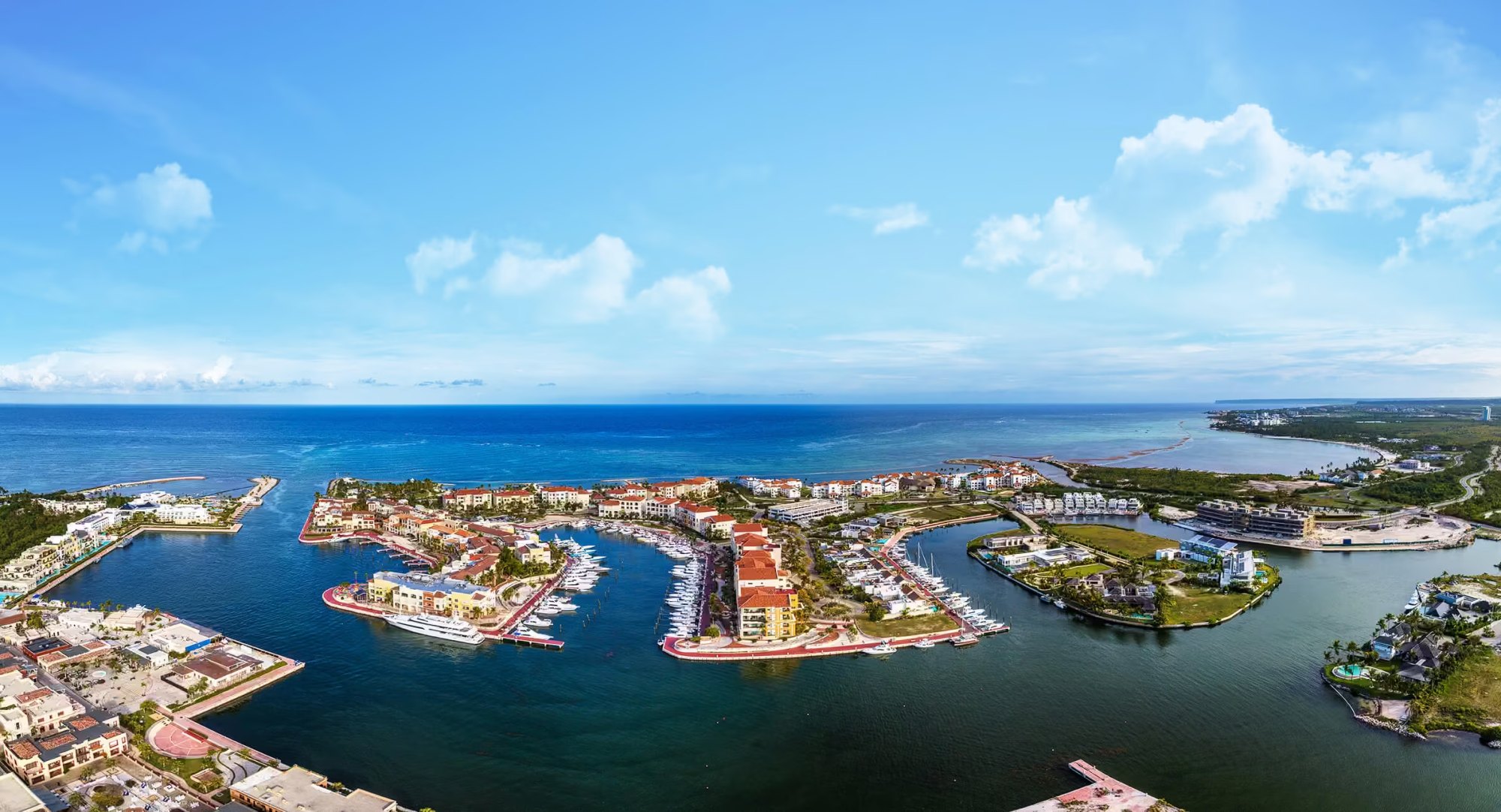
Closer to home is the marina at Cap Cana, about 2.6 miles by road from Crystal Garden. The Ministry's sanctuary plan describes it as the main tourist port facility in this zone and, from its 2024 fieldwork, lists a dive centre there. Confirm that it is operating, and what it runs, before you plan a week around it.
The day trips are on another scale. Bayahibe is about 29 miles west of Crystal Garden in a straight line, reached along the Coral Highway; travel guides put the drive from Punta Cana at under an hour, but no source publishes a door-to-door time from this address, so time it on a visit. Catalina Island is about 40 miles away in a straight line and takes the whole day: the same centre's Catalina trip collects divers at about 7:00 AM, spends about an hour and a half on the road to La Romana and 30 minutes on a boat, and is back in Punta Cana at about 6:00 PM.
Catalina and Bayahibe: what are the day trips for?
Catalina is a small island off La Romana and a protected area in its own right, the Isla Catalina natural monument. Divers go for two sites. The Wall starts as a coral-covered reef at about 5 to 20 feet and then drops away as a wall; the centre quoted on this page takes advanced divers down it to a limit of about 100 feet, and open-water divers to their own limit. The Aquarium is a sheltered reef at about 40 feet, the easier second dive, and lunch is on the island. Close to the shore, the remains of a famous pirate's ship from 1699 were found in 2007 in about 10 feet of water, and the site has been nominated as a Living Museum in the Sea.
Bayahibe, a fishing village west of Cap Cana, is a dive town: the Ministry's fieldwork for its 2024 plan mapped 10 dive centres along its shore. Its deep dive is the St. George, a cargo ship sunk off the village in 1999 as a dive attraction, which the plan places at about 115 feet. That is past even an advanced certification's 100 feet, so plan it with the centre around your training rather than treating it as a sightseeing stop. Shallower, two underwater archaeological preserves at about 16 to 33 feet display cannons, an anchor and other remains from early 18th-century wrecks, laid on the sand the way archaeologists found them, and the plan records manatee sightings along this coast frequent enough to have become a draw for divers.
East of Bayahibe, the coast and Saona Island form Parque Nacional Cotubanamá, still often called by its old name, Parque Nacional del Este: it was declared in 1975 and renamed by a 2014 law. The two names on two different maps are the same park.
When is the best time of year to dive here?
Diving runs all year, and no month wins on every count: the year trades warm water against wind and storms. Modelled averages put the sea at about 79°F in February and March, rising to 84°F in September and October, so the whole year sits within about five degrees, and the centre quoted here finds a thin shorty wetsuit comfortable even in January.
Wind is the bigger variable. The trade wind blows harder from about mid-November to early May and is lightest from May to mid-November, and the same centre describes its sea as calmer in summer and occasionally choppy enough in winter to cancel a dive. Summer and autumn carry the opposite risk: officially, the Atlantic hurricane season covers 1 June to 30 November, and the centre names September to early October as the weeks most likely to disrupt diving, cancelling whenever a storm system passes. Its own pick for an overall window is late April to June and late October to early December, for warm water, low crowds and lower weather risk.
Rain matters less than wind but still counts: the drier season runs from the end of December to the end of April, and in the wetter months, the centre notes, heavy showers can cut visibility for a day or two. If your week is fixed, book it for the reason you are travelling and let the centre choose the site on the day.
| Month | Sea temperature (°F) |
|---|---|
| January | 80 |
| February | 79 |
| March | 79 |
| April | 80 |
| May | 81 |
| June | 82 |
| July | 83 |
| August | 83 |
| September | 84 |
| October | 84 |
| November | 83 |
| December | 81 |
Try dive, course or fun dive: what do you need, and what does it cost?
A try dive is the way in for anyone without a certification. Under the training standard the centre quoted here teaches, it is open from age 10 and is not a certification: a shallow skills session, then an optional dive to a maximum of 40 feet beside an instructor. A centre may keep it shallower, and this one stays within 20 feet. Before it you fill in a medical questionnaire, and some answers mean a doctor must sign you off, which is far easier to arrange at home than on holiday.
An open-water course is the certification itself. The centre quoted here runs it over three days, with four open-water dives and the theory done online before you arrive, and the card it leads to lets you dive with a buddy to 60 feet; divers aged 10 and 11 are limited to 40 feet. An advanced course takes the limit to about 100 feet. A certification does not expire, but the standard advises a refresher once more than six months have passed since your last dive, and a try dive can count toward the course if you start it within a year.
Certified divers simply book fun dives, so bring your card and your logbook. The table shows what one dive centre on this coast publishes, read in October 2026. These are one operator's starting prices on one day, not the price of diving here, and they leave out the transport fee for a Cap Cana pick-up.
| What you book | Published price | What the price covers |
|---|---|---|
| Try dive | From $100 per person | About two and a half hours, equipment and hotel transport, staying within 20 feet |
| Two-tank dive for certified divers | $135 per diver | Two dives |
| Open-water course | $499 | Three days, four open-water dives, equipment and hotel transport |
| Catalina Island day | $220 per diver | Two dives, equipment, lunch and drinks, road and boat transfers |
Which rules protect the reef, and what does diving safely mean here?
The sea off Cap Cana is protected water. It lies inside the Southeast Reefs Marine Sanctuary (Santuario Marino Arrecifes del Sureste), created in 2009 by Decree 571-09 and covering about 3,000 square miles of sea between the Mona Passage, east of Cabo Engaño, and the mouth of the Higuamo river. Its shoreline takes in the Cap Cana and Punta Cana coast, and extending it north to Bávaro and Uvero Alto is, in the Ministry's 2024 plan, still under discussion. Rules adopted in 2017 for the sanctuary's ecotourism zone off Punta Cana made three regular dive sites, known locally as el Acuario, el Museo and el Coliseo, into fishing reserves, banned fishing with compressors and protected parrotfish, sharks and turtles. The plan's zoning lets tourist diving onto the reef only with environmental education about how fragile it is, keeps diving and fishing on separate sites, and closes a few places to tourist diving altogether, among them the elkhorn coral conservation areas off Cap Cana. Catalina's natural monument and Parque Nacional Cotubanamá are separate protected areas beside the sanctuary, not part of it.
For a visiting diver that comes down to habits. The plan names diving without reef-care rules, and careless handling of marine life, among the historic causes of damage to these reefs. Touch nothing, take nothing, keep fins and gauges off the coral, and leave the choice of site to the centre.
Two safety rules matter even more. The first is flying: the consensus guidance from diving medicine asks for at least 12 hours between a single no-decompression dive and a flight, at least 18 hours after several dives or several days of diving, and substantially longer after any dive that needed decompression stops. With the airport about 20 minutes from Crystal Garden, the temptation is one last dive on the morning you leave; the guidance rules it out. The second is what to do if something goes wrong. In a suspected diving injury, the first call is a diving-medicine emergency hotline, which keeps track of which recompression chambers are available and where a diver should be taken, so ask your centre for the number it uses before the first dive. Check, too, that your travel insurance covers scuba diving, and to what depth.
How does diving fit a residence at Crystal Garden?
Crystal Garden is a community of 196 residences on the Las Iguanas golf course in Cap Cana, so the sea is a short trip rather than a step from the door: Playa Caracol is roughly 1,800 feet away on foot, the marina about 2.6 miles by road and the airport about 20 minutes. For a diver, that geography sorts the week. A local reef dive is a morning out and back, Catalina or Bayahibe takes the whole day, and the day you fly belongs to the beach or the golf course.
What changes when you own rather than visit is the certification. A visitor who learns on a one-week holiday gives three days of it to the course; an owner can take the course on one stay and simply dive on every stay after it, because the card does not expire, with a refresher if more than six months have gone by. Two notes are worth keeping in the residence: the door-to-door price from Cap Cana at the centre you use, and that centre's dive-medicine number.
If you let the residence while you are away, guests who dive need the same two notes, plus the one that is easiest to forget on a short stay: with the airport this close, the last dive has to end well before the flight, never on the way to it.
Common questions
- Can you go scuba diving in Punta Cana without a certification?
- Yes, on a try dive. Under the training standard the centre quoted on this page teaches, it is open from age 10, starts with a shallow skills session and can include one dive to a maximum of 40 feet beside an instructor; that centre keeps its own within 20 feet and publishes a price from $100. It is not a certification, so the next step is an open-water course.
- How deep are the dives in Punta Cana?
- Most local reef dives are at about 40 to 60 feet, according to one dive centre's published guide, with shallow sites at about 16 to 40 feet for beginners and advanced sites such as Shark Point at about 85 feet. The Astron wreck lies in about 50 feet of water. Going deeper takes a day trip: Catalina's Wall, which that centre dives to about 100 feet, and the St. George wreck off Bayahibe, which the Ministry places at about 115 feet.
- What is the water temperature for diving in Punta Cana?
- About 79°F in February and March and 84°F in September and October, by modelled monthly averages, with every other month in between. The dive centre quoted here finds a thin shorty wetsuit comfortable even in January. The bigger seasonal variable is wind, which blows harder from about mid-November to early May.
- How long does a Catalina Island dive trip take from Punta Cana?
- A full day. One dive centre's published trip collects divers at about 7:00 AM, spends about an hour and a half on the road to La Romana and 30 minutes on a boat, makes two dives at the Wall and the Aquarium with lunch on the island, and returns at about 6:00 PM, for $220 a diver. Catalina is about 40 miles from Crystal Garden in a straight line.
- How long should you wait to fly after diving?
- At least 12 hours after a single no-decompression dive and at least 18 hours after several dives or several days of diving, under the consensus guidance from diving medicine, and substantially longer after decompression dives. Those are minimums, not guarantees. From Crystal Garden the airport is about 20 minutes away, so keep the day you fly free of diving.
Want the details for your own situation?
Ask about availability, layouts or the buying process, and someone from the sales team will get back to you.
Get in touch