Winter in the Dominican Republic, Seen From a Golf-Front Home in Cap Cana
Ask what winter in the Dominican Republic is like and the usual answer is a temperature and a photograph of a beach. Both are accurate, and neither helps much if you are deciding whether to own a home here. December to March is the country's high season, and two public records describe it better than any brochure: the climate normals that ONAMET, the Dominican meteorological office, supplies to the World Meteorological Organization, and the monthly tables the Banco Central publishes on airport arrivals and hotel occupancy. This guide reads both from Crystal Garden, a development of 196 residences on the Las Iguanas golf course inside Cap Cana, scheduled for delivery in 2027.
Rain, not degrees, is what changes
The thermometer hardly moves through the northern winter. At the Punta Cana station, the long-term normals put daytime highs from December to March at about 82°F and nights at 71 to 72°F. Even September, the warmest month by its average maximum, only reaches 87.6°F. There is no cold month to plan around, and nothing in the record suggests you will need more than a light layer on a terrace after dark.
What shifts is the rain. December is not much drier than autumn by the count of rain days, 11 against 10.4 in September, but the showers are lighter: 3.1 inches on average, against 4.0 inches in September and 6.0 inches in October. The real change arrives later. January averages 10 rain days and 2.6 inches, and by February and March the count drops to 6.8 and 6.7 days with about 2.1 inches each. These are averages over 1961 to 1990 from a station at the airport, north of Cap Cana, so treat them as the outline of a typical season rather than a promise about a particular week.
The sea cools only slightly with the air. Modelled estimates put the water at about 81°F in December, 80°F in January and 79°F in February and March, and near the winter solstice the day still carries roughly 11 hours of daylight. We found no official sunshine-hours record for this coast, so this page does not quote one.
Why a golf-front address suits these months
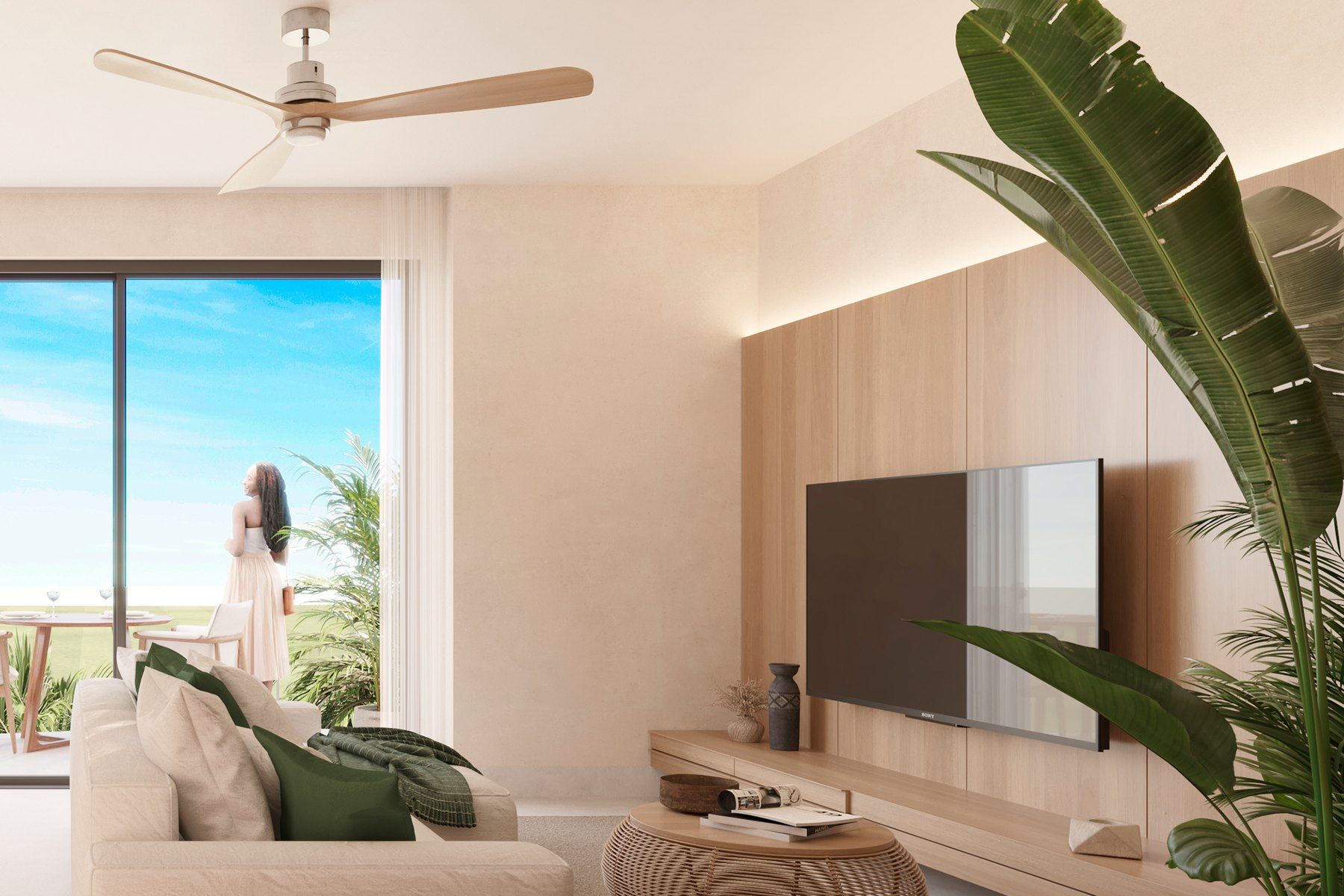
Crystal Garden does not sit on the sand. Its buildings front the Las Iguanas golf course; Playa Caracol is roughly 1,800 ft away on foot, about ten minutes, and Juanillo Beach is an 8-minute drive. In a wet month that arrangement would feel like a compromise. In a dry one it is closer to the point, because the days you are most likely to spend outside are exactly the days a fairway, a pool deck and a rooftop are at their most usable.
The amenities the development publishes lean the same way: a rooftop pool and a resort pool, pickleball courts, barbecue terraces and on-site restaurants. The rest of the list, the spa, the gym and the coworking space, is what you fall back on when a shower does pass over. With fewer than seven rain days a month on average in February and March, the outdoor half of that list is the half you will actually use.
The same geography cuts the other way for anyone who wants to step from the bedroom straight into the sea. Here the beach is a walk or a short drive rather than the view from the terrace, and a winter plan should be built around that honestly.

How full the coast gets, month by month
The weather explains why people come; the Banco Central's tourism tables show how many do. In 2025, 536,574 foreign non-resident passengers landed at Punta Cana International Airport in December and 528,914 in March, the two heaviest months of that year, against 278,783 in September, the lightest. January and February brought 470,018 and 455,468.
Hotel occupancy tells the same story from the other side. ASONAHORES, the hotel and tourism association, reports average occupancy for tourist lodging in the Punta Cana/Bávaro zone, and the Banco Central republishes it: 89.9% in January 2025, 92.2% in February and 87.5% in March, with December at 87.3%. September slipped to 62.2% and October to 70.0%, and the year as a whole averaged 81.6%. The opening months of 2026 ran higher still, at 90.8%, 93.5% and 92.1% from January to March.
Two limits apply. These are hotel figures for an entire zone, not the occupancy of any apartment, and nothing on this page turns them into a rental forecast. What they do show plainly is the shape of the year: winter is when the area is fullest, and early autumn is when it is quietest.
| Month | Rain days (average) | Rainfall (average) | Hotel occupancy, 2025 | Foreign arrivals at the airport, 2025 |
|---|---|---|---|---|
| December | 11 | 3.1 in | 87.3% | 536,574 |
| January | 10 | 2.6 in | 89.9% | 470,018 |
| February | 6.8 | 2.1 in | 92.2% | 455,468 |
| March | 6.7 | 2.1 in | 87.5% | 528,914 |
| September | 10.4 | 4.0 in | 62.2% | 278,783 |
| October | 11.4 | 6.0 in | 70.0% | 344,423 |
Spending the busy months in the residence yourself
If you plan to winter at Crystal Garden, the figures above become ordinary logistics. The airport is about 20 minutes away by car, but it handles its heaviest foreign traffic of the year in December and March, so an arrival day on a holiday weekend takes longer than the drive time alone suggests. Restaurants and beach clubs across the area are shared with every hotel guest in a zone where roughly nine rooms in ten are taken.
Arriving as a resident rather than a guest changes that experience. Your home does not have to be booked around a hotel's availability, the concierge lobby belongs to your own building, and the gym, spa and coworking space are there on the days you would rather not drive anywhere at all. For a stay of several weeks, a residence turns the high season from something you compete for into something you simply live in.
Renting it out while the coast is full
An owner who lets the residence meets the same calendar from the opposite side. The weeks that make a winter pleasant to live in are the weeks the zone's hotels report their highest occupancy, so each night you keep for yourself in February is a night taken out of the strongest stretch of the year for visitors. Leaving the residence free over the winter and visiting in the autumn reverses the trade, but October is also the wettest month on the station's record.
The investment calculator on this site starts from a 70% occupancy assumption, which you can move with a slider. That is a modelling input, not a measured occupancy for this building or any other, and the hotel data above is no substitute for it. What the two public records do support is a practical question to put in writing before you buy: who would manage, price and clean the residence between guests during the months when demand is concentrated, and what happens to that work while you are not there.
Common questions
- Is December as dry as February in Punta Cana?
- No. On the ONAMET averages December brings 11 rain days and about 3.1 inches of rain, while February falls to 6.8 days and roughly 2.1 inches. If a dry stretch matters most to you, late winter is the more dependable choice.
- Is the sea warm enough for swimming in winter?
- For most swimmers, yes. Modelled estimates put the water near 81°F in December, easing to about 79°F by February and March. Those are averages, not a reading for any particular day.
- Do hotel occupancy figures tell me how often a Crystal Garden residence would be rented?
- No. The ASONAHORES figures published by the Banco Central measure occupancy in hotels and tourist lodging across the whole Punta Cana/Bávaro zone. They show when demand peaks, not what any apartment would achieve, and this page does not turn them into a rental estimate.
- When is the first winter I could spend at Crystal Garden?
- The development is scheduled for delivery in 2027, so the first winter season it can host is the one that follows handover. The date that applies to your own residence is a question for the purchase contract.
Want the details for your own situation?
Ask about availability, layouts or the buying process, and someone from the sales team will get back to you.
Get in touch