Safety in Punta Cana, Taken One Route at a Time
Safety in Punta Cana is easiest to judge one route at a time, because what you need to watch changes with where you are going, not with the region's reputation. From Crystal Garden, a 196-residence building on the Las Iguanas golf course inside gated Cap Cana, those routes are short and specific: the grounds themselves, a walk of about 1,800 ft to Playa Caracol, 8 minutes by car to Juanillo, about 20 minutes to the airport and about 30 to Downtown Punta Cana. This guide takes each in turn and separates what is published from what you should ask or do.
Why judge safety by route rather than by reputation?
Anyone typing seguridad en Punta Cana into a search bar is usually hoping for a verdict, and the official record does not hand one down at the local level. When we read their pages on 30 August 2026, none of the five governments we checked — the United States, Canada, the United Kingdom, France and Germany — tells its citizens to avoid the Dominican Republic. Canada's page, last modified on 24 September 2026, keeps a single instruction for the entire country, a high degree of caution, and names crime as its reason. No government sets a separate level for Punta Cana or Cap Cana, and no official Dominican source breaks crime down below the level of the province, so this page prints no figure and holds the area up against nowhere else.
What the record does support is practical advice tied to settings: the parked car, the cash machine, the hotel room, the open sea, the highway. Those settings are not spread evenly across a day. An owner at Crystal Garden moves through them in a fairly predictable order, fixed by the distances the development publishes, and that order is the most useful map of risk on offer. The table lays the routes out; the sections after it walk them one by one.
| Route | How far | What changes | First precaution |
|---|---|---|---|
| The grounds, on the Las Iguanas course | On-site | A gated, staffed building where some neighbours may be rental guests | Keep passports and spare cards out of the residence while it is let |
| Playa Caracol | About 1,800 ft on foot | The sand is public and the gate is behind you | Read the water and obey local warnings |
| Juanillo Beach | 8 min by car | A parked car enters the picture | Leave nothing visible inside it |
| Punta Cana International Airport | About 20 min by car | First cash machine, first rental car, first highway | Cover the keypad and withdraw inside a bank or business |
| Downtown Punta Cana | About 30 min by car | Open public streets outside Cap Cana's gate | Save 911 and the tourist police's current line |
What does the building itself publish, and what should you ask?
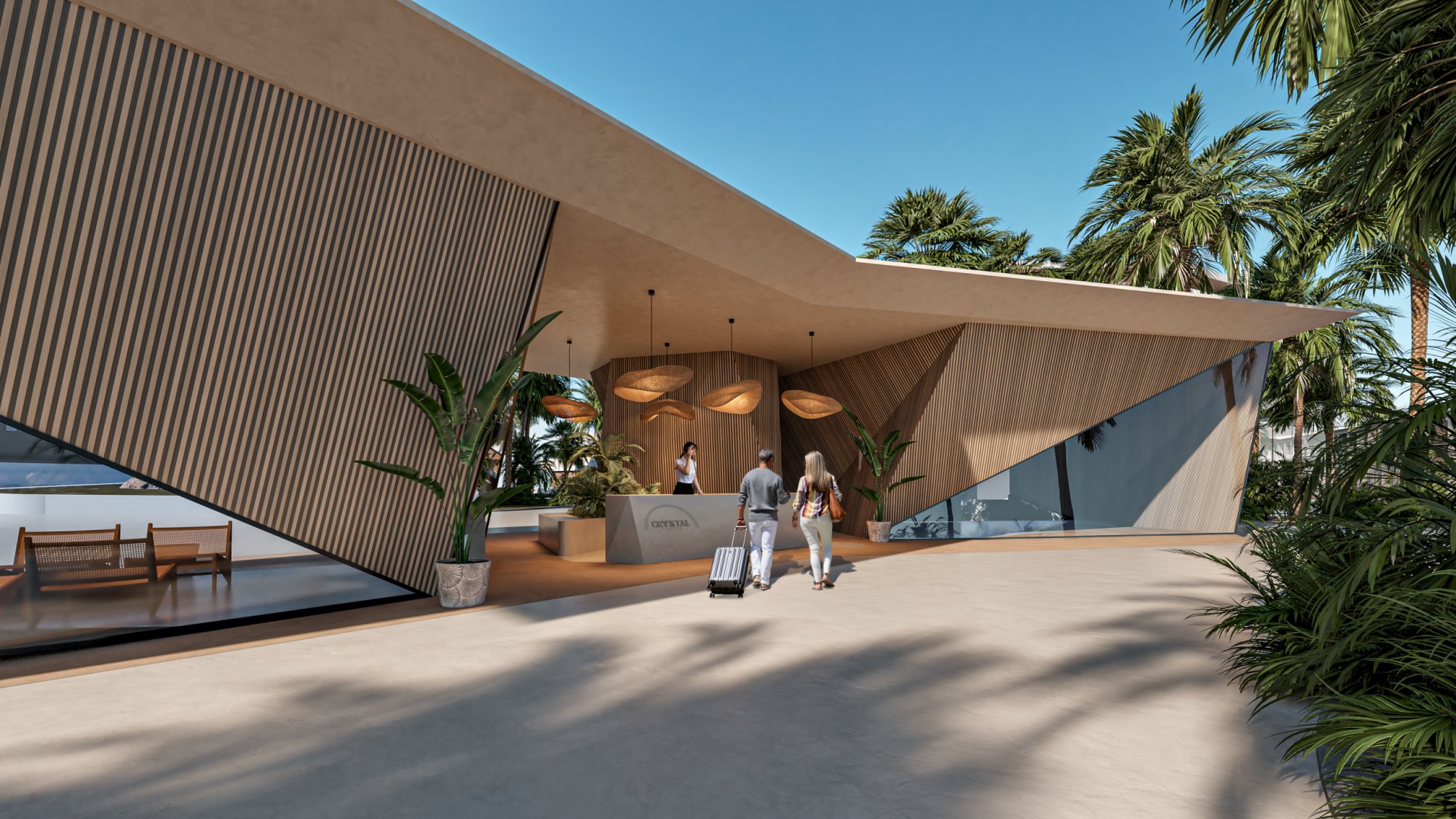
Crystal Garden is two curved buildings holding 196 residences between them, set directly on the Las Iguanas fairways, and its published amenity list names the protection it intends to provide: 24/7 gated security and a concierge lobby, alongside one parking space per residence. Delivery is projected for 2027, so these are commitments written into a plan rather than an operation anyone can walk through yet. That is a reason to pin the details down now, not a reason to doubt them.
One feature shapes the questions more than any other. The development is set up as a condo-hotel with an optional managed rental programme, so on any given night some of your neighbours may be short-stay guests rather than owners. That is normal for the format, and it moves the sensible precautions indoors. Global Affairs Canada lists resorts and hotels among the places where theft happens in the country, including inside private rooms and in-room safes. Treat a safe as a convenience, not a vault: passports, spare cards and anything irreplaceable travel with you, or are not left in the residence at all while it is let.
Three questions deserve a written answer before you sign. Who will employ the guards, and does that contractor hold a licence from the Superintendencia de Vigilancia y Seguridad Privada, the one state regulator of private security, created by decree in December 2003? How is a departing rental guest's access cancelled before the next guest arrives? And how will the concierge lobby confirm that a visitor asking for your residence is actually expected?
On foot to Playa Caracol: where does the gate stop?
The shortest route from the building is also the one where its protections end soonest. Playa Caracol is roughly 1,800 ft away, about a ten-minute walk, and the moment your feet reach the sand you are standing on public land. Ley 305 of 1968 puts the coastal strip, roughly the first 200 feet inland from the high-tide line, in public ownership along the entire Dominican shoreline, and no gate, hotel or community can lawfully turn it into a private beach. Cap Cana's access control governs its roads. It does not, and cannot, decide who is on the shore.
That is a change of setting rather than a cause for alarm, and it calls for beach habits rather than building habits: carry what the afternoon needs and leave the passport behind. The bigger beach question is the water. Canada's advice warns that coastal waters across the country can be dangerous, that shifting tides and strong winds can whip up riptides, and that lifeguard and rescue cover does not always reach Canadian standards. It tells visitors to obey the instructions and warnings of local authorities, and that is the rule worth keeping: if a flag or a sign says stay out of the water, stay out.
Blue Flag certification has been held by some managed stretches of the Punta Cana coast, and it requires lifeguard cover and first-aid equipment among its conditions. It is renewed season by season and attaches to one operator's stretch, never to a whole named beach, so the flag speaks only for the sand it stands on, and where there is none you should look for cover before you swim. The same reasoning holds at Juanillo, 8 minutes away by car, with one addition: you now have a parked car, and Canada names the inside of cars, rental cars above all, among the places where theft happens. Leave nothing on the seats.
The 20-minute airport run: what matters on arrival day?
Arrival day concentrates more of the official advice than any other day of a stay. Punta Cana International Airport is about 20 minutes from the development by car, and within that short stretch most owners meet their first cash machine, their first rental counter and their first Dominican highway. The tourist police, Politur, also known as Cestur, publishes that its agents work at the airport as well as in Punta Cana and Bávaro. The force traces back to a decree of December 2000 and has sat inside the National Police since an organic law of 2016, so it is a police service, not a hotel courtesy.
-
Withdraw cash with care Canada reports card-reader tampering as a common scam in the country. Use a machine inside a bank or a business, or in a busy public spot, and shield the keypad while you type your PIN.
-
Check what your licence covers Secondary sources report that INTRANT, the road authority, lets visitors drive on a home-country licence for roughly the first 90 days of a stay. That is an administrative practice nobody here has found written into the statute, so confirm it before relying on it; an International Driving Permit is recommended rather than required.
-
Drive defensively Canada describes Dominican road conditions as varying greatly, says accidents are frequent, and notes that drivers often speed and do not always respect traffic laws. Leave room, keep your speed modest and never assume another driver will yield.
-
Load the car once Put luggage straight into the boot instead of leaving bags on the back seat during a stop. Rental cars are the example Canada singles out when it describes theft from vehicles.
Thirty minutes to Downtown Punta Cana: what is different outside the gate?
Downtown Punta Cana, about 30 minutes away by car, is the one route on this list that takes you entirely outside Cap Cana's access control and onto open public streets, with shops, banks, restaurants and traffic that nobody screens. That is no reason to stay away; it is simply the setting where ordinary city habits apply. Politur keeps a standing sub-command for the Bávaro–Punta Cana area, so the tourist police are part of the landscape here and not only at the airport.
The habits are the ones already covered, used together: cash from a machine inside a bank, nothing left in view in the car, valuables on you rather than in a bag hung on a chair. In an emergency, Canada tells travellers to dial 911 and, in tourist areas, to contact Cestur. This page deliberately prints no direct line for the tourist police, because published numbers change and a stale one is worse than none, so save the current number from a local source when you land.
The building-level answers are the part of this map only the development can complete. If you want the guard contractor, the guest-access routine and the visitor procedure confirmed in writing, ask for them through the enquiry form on the main page, and keep the replies with your purchase documents.
Common questions
- Is the beach at Playa Caracol part of Cap Cana's gated area?
- Not in law. Ley 305 of 1968 makes the coastal strip, roughly the first 200 feet inland from the high-tide line, public property along the whole Dominican coast, so no community or hotel can make it private. Cap Cana controls who drives in on its roads, but the sand itself is open to anyone who reaches it. Treat the beach as a public place and follow local warnings about the water.
- Does any government rate Punta Cana separately from the rest of the country?
- No. On 30 August 2026, the date we read them, none of the five governments we checked told its citizens to stay away from the Dominican Republic, and none set a different level for Punta Cana, Bávaro or Cap Cana. Canada's page, modified on 24 September 2026, asks for a high degree of caution across the whole country. Check your own government's page before you travel, because these positions change without notice.
- Who provides security at Crystal Garden?
- The published amenity list includes 24/7 gated security and a concierge lobby. The company that will employ the guards has not been published, which is unsurprising for a building due in 2027. Ask for it in writing, and confirm the contractor is licensed by the Superintendencia de Vigilancia y Seguridad Privada, the regulator of private security.
- What number do I call in an emergency near Cap Cana?
- Dial 911. Canada's advice also tells travellers in tourist areas to contact Cestur, the tourist-security police also known as Politur, which publishes that it operates at the airport and in Punta Cana and Bávaro. This page prints no direct line for it because such numbers change; take the current one from a local source when you arrive.
Want the details for your own situation?
Ask about availability, layouts or the buying process, and someone from the sales team will get back to you.
Get in touch