Punta Cana Real Estate: Which Figures Were Measured, and Which Were Assumed?
Researching property here means being handed dozens of figures with no indication of where any of them came from, and the ones that will cost a buyer money are rarely the ones that look shakiest. A tax rate lifted from a statute, an arrivals total compiled by a central bank and a yield produced by somebody's spreadsheet all print in the same font. This page separates them by provenance, then turns the same question on the project it is published beside — Crystal Garden, a 196-residence development in Cap Cana.
Why two figures on the same screen are rarely worth the same
Provenance is invisible on a results page. A statistic compiled by a central bank, a percentage copied out of a tax code and a return worked up by whoever wants the sale all arrive formatted identically, and a buyer with no way to tell them apart ends up weighting them by how confident they sound. That is backwards, because confidence is cheapest to produce for the figures with the least behind them.
Ask one thing of any number on this subject: what produced it? The answers fall into three groups.
- Measurement. An institution observed something, defined what it was observing, and published the result with a date on it. Airport arrivals, a consumer-price series, an exchange rate. The publication can be opened and read.
- Legislation. The figure is a line in a law. It is not an approximation of anything, and it holds until a legislature amends it.
- Assumption. Somebody picked inputs and reported what came out. Rental yields, occupancy, forecast returns. Nothing here was observed; the output simply describes the inputs chosen.
Trouble in this market usually begins when the third group is read as though it belonged to the first. What follows works through the figures a buyer encounters in practice.
| Provenance | Example | Who produces it | What verification looks like |
|---|---|---|---|
| Measurement | 5,275,492 foreign arrivals via Punta Cana during 2025 | Banco Central tourism flow reporting | Open the publication; read the definition |
| Legislation | Transfer tax of 3%; annual IPI of 1% | Dominican tax statutes; CONFOTUR | A Dominican attorney, statute in hand |
| Assumption | A forecast yield of 8–11% a year | Whoever stands behind the forecast | Obtain the inputs; substitute your own |
Measured: what institutions here actually observe and publish
Demand for this coast is visible through an arrivals count, which is the sturdiest evidence the market offers. During the 2025 calendar year the country logged 8,860,709 non-resident air arrivals, of which 5,275,492 foreign non-resident arrivals came through Punta Cana International Airport — 71.9% of the national figure, per the Banco Central's tourism flow reporting. Take it literally: it counts people getting off aeroplanes. Purchases, rentals and prices paid are all outside what it measures.
Broader indicators come from the same institution and need the same discipline. Economic output was up 2.1% for calendar 2025 on preliminary figures, a slowdown the bank puts down to global uncertainty, financial conditions tighter than anticipated, and private investors deferring projects. Prices to consumers climbed 4.95% across that year on a December-to-December basis, which the bank characterises as sitting within its own target band. Construction value added shrank by 1.8% over 2025, then grew 14.9% against the same month a year earlier in June 2026 — measured off a soft base. Those last two readings are the whole argument in miniature: an annual figure and a single monthly one, moving in opposite directions, neither of them saying anything whatever about an individual project.
Currency is measured too, and the two quotations a buyer will be shown are not interchangeable. Averaged across calendar 2025, the peso's spot purchase rate against the dollar came to RD$61.52. On 9 September 2026 the bank's published daily reference rate stood at RD$58.63 to buy a dollar. One is a twelve-month average, the other a single session's quote, and the second is overwritten every working day — so the rate worth knowing is the one published on the day funds actually move.
Then there is the figure nobody measures. This market has no published price index behind it. What the Banco Central's methodology paper describes is an index assembled from mortgage-lending records submitted to the bank by financial institutions: 92,934 entries covering financed properties across the country from June 2018 through June 2021, 89,239 of them dwellings. Because the Distrito Nacional, Santo Domingo and Santiago between them supply 84% of the entries — and most provinces supply too few to be usable — the resulting indicator was narrowed to the metropolitan zone of the Distrito Nacional and Santo Domingo. La Altagracia, the province containing Punta Cana, falls outside it. Extending such an index would not solve much either: one built on local mortgage lending can only ever see homes financed that way, which a second-home resort market largely is not.
Anyone hunting for the Punta Cana price per square foot is therefore hunting for something no institution compiles. Asking prices exist in abundance, but an asking price is where a seller opens, not a measurement of anything.

Legislated: the figures a lawyer can read back to you
Tax rates hold up better than anything else a buyer is shown here, for the simple reason that they were never estimated. They are wording in a statute, and wording changes only when a legislature changes it.
On acquisition. Transferring property attracts tax of 3% on the registered value, settled at closing.
Annually thereafter. IPI, the recurring property tax, runs at 1% — and applies only to whatever portion of the value sits above an exempt threshold that is restated each year. It does not apply to the value as a whole, which is the qualification most summaries lose.
CONFOTUR. Under Law 158-01, as amended by Law 195-13, an approved tourism project's initial purchasers are relieved of both. Three qualifications carry more weight than the headline does. The relief is drafted for those buying first from the developer, which is why a later owner does not inherit it. Nothing about it is automatic: an application has to be made and the exemption recorded against the title. And the fifteen-year figure in general circulation is the exemption period the statute establishes, measured from when construction is completed under Article 7 — language written with the developer companies in view. Rather than assume that period transfers to you unchanged, have an attorney tell you what is actually recorded against your title.
Where the residence is let out. Two rules, distinct from each other, and the pair most often missing from a headline return. Short-stay tourist accommodation attracts ITBIS at 18%, whereas a home let for permanent habitation does not — and liability rests with the host rather than with any booking platform. Separately, sums paid out of the country to a non-resident attract income-tax withholding of 27%, applied to gross income without deductions, settled once and finally. Any return quoted to you that ignores both is not a net number.
Two further rules that shape a lot. Tax residency begins once 182 days in the country have been spent within a year, and holding a residency permit is a different status from being resident for tax. Meanwhile a buyer from abroad can hold registered freehold in their own name on identical terms to a Dominican citizen — nationality is not restricted, residency is not required, and no approval stage exists — with registration handled under Ley 108-05.
Thresholds and rates are amended from time to time, and a published page has no way of knowing when that happens. Put every figure in this section to a Dominican attorney or accountant on the day it becomes relevant to you.
Assumed: the class that carries all of the risk
Yield is arithmetic, not observation. Feed it a letting rate, a share of the year occupied, a cost of administration, a building's annual charges and the deductions described above, and it returns a percentage that reflects precisely those choices. Alter any one of them and the headline moves, which is why two people acting in good faith can publish quite different returns for the same building.
What deserves asking of a forecast is what went into it. The calculator on this site names its own inputs: a two-bedroom at $475,000 letting at an average of $325 nightly, occupancy forecast at 70%, administration charged at 25%, and operating charges of roughly $10,460 annually. Every item on that list is a supposition about a building still under construction.
For the optional managed rental programme the published band is 8–11% a year. That is the developer's forecast rather than a record of results, and neither swallowing it nor waving it away is much use. Interrogating it is: across what period was it worked out, which nightly rate and which occupancy underpin it, has the administration charge already been subtracted, and does it sit before or after the 27% withholding and the 18% ITBIS on short stays? Give a buyer the inputs and the forecast becomes testable. Hand over a single percentage and nothing can be done with it.
Two disciplines are worth adopting. Re-run the sums on a lower occupancy than the one presented, since occupancy shifts the outcome further than any other input and no one is in a position to promise it. And read the charges line as cash leaving the account: $10,460 in the example above goes out annually, in strong letting years and weak ones alike.
The commitment that no figure can express: a handover date
What a pre-construction buyer is really underwriting is a dated undertaking, and no statistic reaches it. No index values it and no national aggregate comments on it. Standing in for a number is a track record, and a track record consists of documents that can be requested.
Handover for Crystal Garden is set for 2027, with the project published as 89% sold. Gesproin Group, the developer, builds across Punta Cana and Cap Cana, and this is the seventeenth scheme in its portfolio; MORPH, a Spanish studio whose work took the OPAL architectural design award in 2021, designed the buildings.
Statements of that kind invite examination rather than belief, and the follow-up questions are concrete ones. What has this developer completed, and on what timescale? Is there dated construction reporting for this site? Has the project's CONFOTUR resolution been issued and filed? What exactly does the contract undertake regarding handover, and what applies if the date slips? Each of those resolves into a document rather than a percentage, and that is why this category stands up better than a forecast does: verification is available, just not from a spreadsheet.
Applying the test to the development behind this page
Finishing on the market in general would be the comfortable option. Applying the same test to Crystal Garden is the useful one.
Measured: nothing yet, and necessarily so. Handover falls in 2027, so no trading history, no occupancy record and no achieved return can exist — none of them can predate opening. That describes where the project stands rather than passing judgement on it, and it is the reason the assumed figures attached to anything pre-construction warrant the questioning set out above.
Legislated: the legal footing. CONFOTUR standing, freehold registered in the purchaser's name, and the rates covered earlier apply here exactly as they apply anywhere in the country — always subject to what an attorney confirms has been recorded against a specific title.
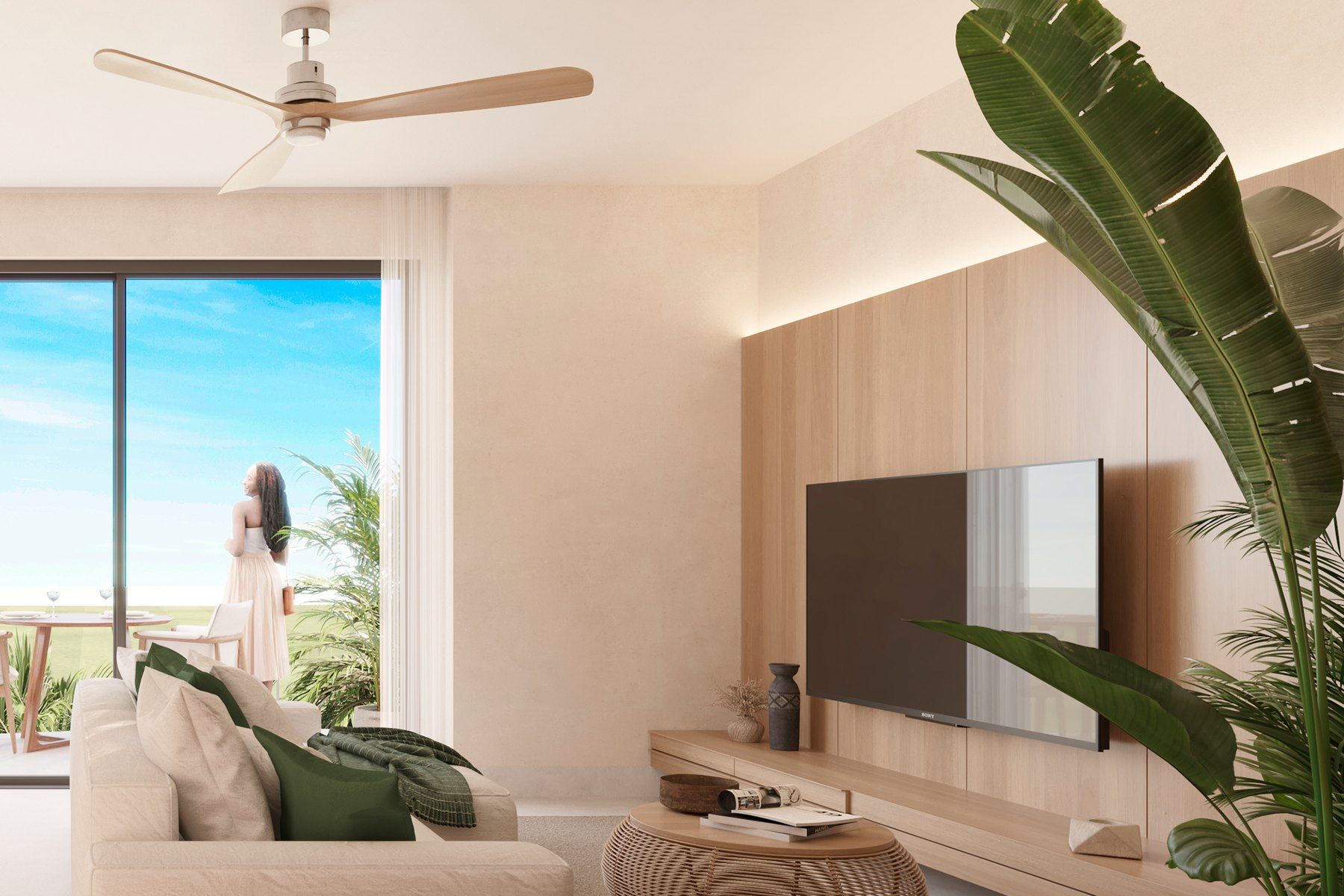
Published by the developer, and testable against a contract, a plan and a map. Two mid-rise buildings on the Las Iguanas golf course in Cap Cana hold 196 residences, priced between $475,000 and $750,000. Published interior areas begin near 920 sq ft for a two-bedroom and reach around 1,360 sq ft for a three-bedroom before terraces are counted; the same three-bedroom shows on its floor-plan card at approximately 2,250 sq ft with terraces included, and those two bases must never be treated as one. On foot, Playa Caracol lies roughly 1,800 ft away. Juanillo Beach is 8 minutes out by car, the Cap Cana Marina around 2.6 miles by road, and the airport some 20 minutes away.
Assumed: the 8–11%. Exactly one figure in that paragraph belongs to the third category, and it is the one to press hardest on.
None of this amounts to saying assumed figures are worthless — anybody who refuses to model a return cannot invest at all. It says that measured and legislated figures are the ones available for checking before money is committed, while assumed ones remain open to argument afterwards.
Common questions
- Is there a price index published for Punta Cana real estate?
- No institution compiles one covering this market. The index described in the Banco Central's methodology paper draws on mortgage-lending records reported to the bank, and since 84% of those records come from the Distrito Nacional, Santo Domingo and Santiago, it was narrowed to the metropolitan zone rather than extended nationally. Punta Cana sits in La Altagracia, which is outside it. Where a specific property is concerned, what can be checked is the contract, the floor plan, the title and the CONFOTUR file.
- Which figures can a buyer confirm before signing?
- The legislated ones and the measured ones. A Dominican attorney can confirm the rates against the statutes themselves — 3% on transfer, 1% IPI above the exempt threshold, 18% ITBIS on short-stay accommodation, 27% withheld on income paid to a non-resident. Arrival counts, inflation readings and exchange rates are all published by the Banco Central and can simply be read. Title registration and a project's CONFOTUR resolution are documents that either exist or do not.
- What weight should a forecast annual return carry?
- Treat it as the product of assumptions and insist on seeing them. A band such as 8–11% rests on a nightly rate, an occupancy share, an administration charge and an annual charges line, and shifts as soon as any of those shifts. Establish the period it covers, whether administration has already been deducted, and whether the figure precedes or follows the 27% withholding and the 18% ITBIS. Forecasts guarantee nothing, and one presented without its inputs cannot be examined at all.
- If the purchase is in US dollars, does the peso still matter?
- It reaches your costs rather than your purchase price, which makes the two quotations worth separating. Across calendar 2025 the peso's average spot purchase rate against the dollar was RD$61.52; the daily reference rate published on 9 September 2026 was RD$58.63 per dollar. A twelve-month average and one session's quote measure different things, and the latter is replaced every working day, so check the rate current on the day a payment is actually made.
- Can national growth figures say anything useful about one building?
- Hardly anything, and the latest readings demonstrate why. Construction value added contracted 1.8% over calendar 2025, then expanded 14.9% year on year in June 2026 from a soft base — one covers a year, the other a single month, and both describe a national sector. No aggregate can indicate whether a given developer completes on schedule or whether a given residence lets well. A track record and a contract answer those questions; an economy does not.
Want the details for your own situation?
Ask about availability, layouts or the buying process, and someone from the sales team will get back to you.
Get in touch